
Algorithm of Power: Artificial Divinity and Erasure

In an era where political identity is increasingly mediated through screens, algorithms, and spectacle, the line between leadership and mythology has begun to blur. Few figures embody this transformation more than Donald Trump, a man who not only dominates headlines but also serves as a digital canvas on which narratives of power, persecution, and even divinity are projected.
Recently, an AI-generated image depicting Trump in a Christ-like form circulated across social media. To some, it was satire. To others, devotion. But beneath the surface lies something far more consequential: the merging of political authority with religious symbolism in a digitally accelerated world.
Manufactured Divinity in the Age of AI
Artificial intelligence has given ordinary users extraordinary power, the ability to create images that once required studios, artists, and intent. Now, with a prompt and a few clicks, anyone can construct a narrative. The Trump-as-Christ imagery is not simply a meme; it is a signal.
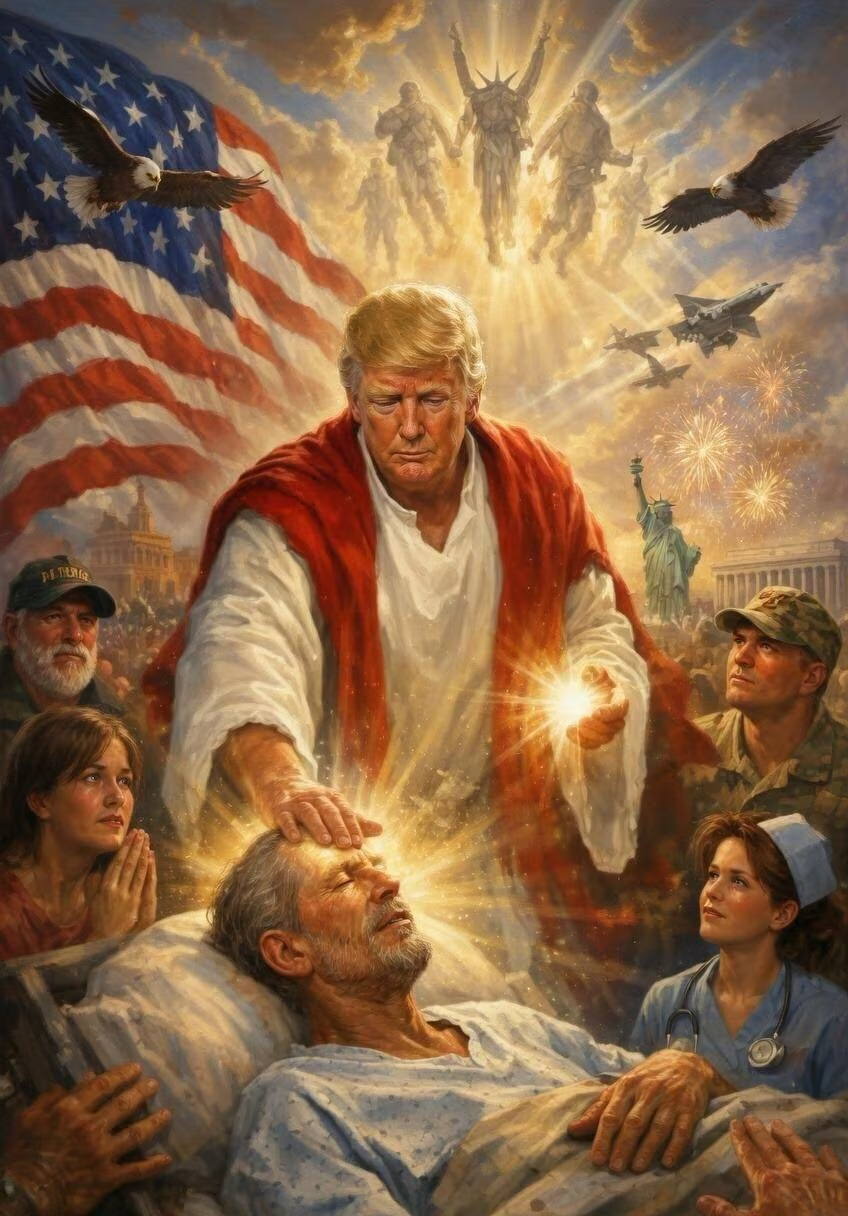
It reflects a growing tendency to elevate political figures beyond governance and into the realm of moral or spiritual authority. Historically, such elevation has been dangerous. Leaders portrayed as saviors are rarely held accountable like ordinary politicians. Instead, criticism becomes heresy, and opposition becomes betrayal.
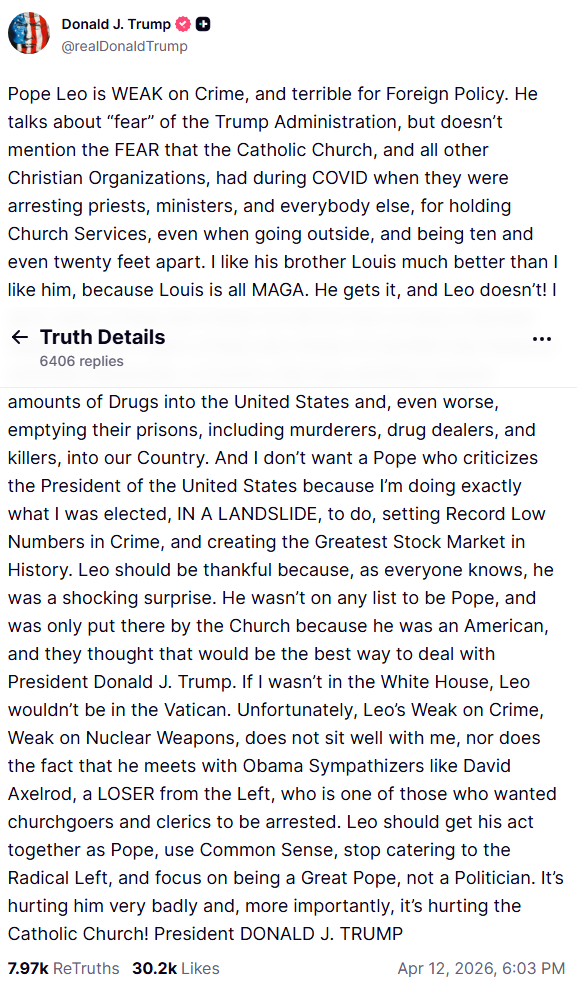
He even went so far as to publicly criticize the Pope, launching into a lengthy, pointed rant on his Truth Social platform that blurred the line between political grievance and religious confrontation. In doing so, he did not merely challenge a global spiritual leader but signaled a broader willingness to position himself in opposition to traditional moral authority, reinforcing the image of a figure who operates outside conventional institutional boundaries.
This moment, amplified online and consumed by millions, further illustrates how his rhetoric increasingly transcends policy disputes and enters the realm of symbolic power where political figures are no longer just leaders, but contenders in a larger narrative about authority, legitimacy, and belief.
In Trump’s case, this phenomenon did not begin with AI. His rhetoric, branding, and relationship with segments of the electorate have long carried undertones of personal loyalty over institutional trust. The AI image merely crystallizes what has been building for years: a symbolic transformation from leader to figure of near-religious significance.
The Language of “Wiping Out”
Equally striking and far more troubling are the political narratives surrounding conflict, migration, and identity that have accompanied Trump’s public life. His rhetoric has often leaned into absolutism: total victory, complete removal, eradication of threats.
When phrases like “wiping out” a group, movement, or even an entire “civilization” enter mainstream discourse, they do more than provoke; they reshape the boundaries of acceptable language. Words matter. They frame policy, justify action, and, in extreme cases, normalize the unthinkable.
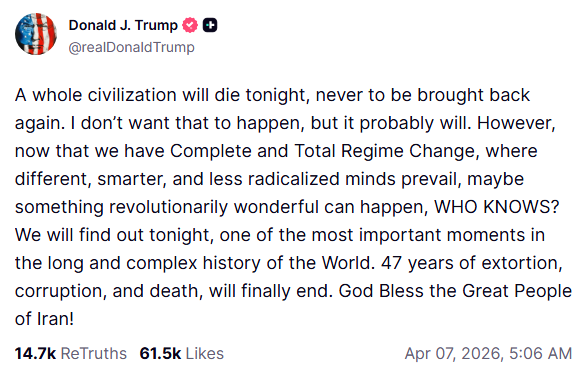
It is important to clarify: no modern civilization has been literally erased under Trump’s leadership. However, the rhetorical framing, whether directed at political enemies, cultural groups, or foreign adversaries, can echo historical precedents where language preceded action. History has shown, time and time again, that dehumanization often begins with metaphor.
Digital Mythmaking Meets Real-World Consequences
The convergence of AI imagery and charged rhetoric creates a feedback loop. Visuals amplify narratives; narratives justify visuals. A Christ-like image of a political figure does not exist in isolation; it interacts with speeches, policies, and public perception.
This matters because perception shapes reality. When a leader is seen as a savior, their actions may be interpreted as necessary, even when controversial. When opponents are framed as existential threats, extreme measures begin to feel justified.
This is not unique to Trump, nor to the United States. Across the globe, political figures are increasingly leveraging digital tools to construct mythologies around themselves. What makes this moment distinct is the speed and accessibility of AI. The barrier between imagination and mass distribution has effectively disappeared.
Support The Journal
Support local reportage that matters. Join Arias Pro for exclusive stories and adept insights.
A Warning from History
The fusion of political authority with divine imagery is not new. From emperors claiming godhood to regimes elevating leaders as infallible, history offers countless warnings. These systems often share common traits: centralized power, diminished dissent, and a narrative that places the leader above ordinary scrutiny.
The AI-generated image of Trump as a Christ-like figure should be understood within this broader historical context. It is not just a viral post; it is part of a continuum where technology accelerates age-old patterns of power.
The Responsibility of the Viewer
In this environment, responsibility does not lie solely with politicians or creators. It extends to the audience, the millions who view, share, and interpret these images.
To engage critically is no longer optional; it is essential.
What does it mean when a political figure is portrayed as divine?
What assumptions are embedded in that image?
And perhaps most importantly: who benefits from that perception?
Power, Perception, and the Future
The story of Donald Trump and the Christ-like AI image is not just about one man or one moment. It is about the evolving nature of power in the 21st century, where technology, symbolism, and rhetoric intertwine to shape public consciousness.
We are entering an age where leaders are not just elected, they are rendered, edited, and reimagined in real time.
The question is not whether this will continue. It will.
The question is whether society will recognize the difference between leadership and mythology before that mythology begins to dictate reality.
Continuing the Conversation
We explored this very dynamic in greater depth on The Arias Journal Podcast, where we unpacked the implications of political mythmaking, AI-generated imagery, and the evolving relationship between power and perception in today’s media landscape.
The conversation moves beyond headlines, offering a more candid and analytical discussion on what these moments mean for the future of public discourse. Readers are encouraged to follow up by listening to the full episode on Spotify, where the discussion continues with the nuance and context that this topic demands.